SEO vs AEO vs GEO: The Future of Search in 2026
SEO is evolving with AI-powered search. Discover how AEO and GEO help businesses improve online visibility and reach customers in 2026.
Introduction: Search Is Changing
For years, businesses have followed one primary digital marketing strategy: Search Engine Optimization (SEO). The goal was straightforward—rank higher on Google, attract organic traffic, and convert website visitors into customers.
But the way people search for information is changing.
Today, users increasingly ask questions through AI-powered experiences, including Google's AI Overviews, ChatGPT, and other AI assistants. Instead of browsing multiple websites, they can receive summarized answers, recommendations, and links to relevant sources in one place.
This shift is changing how businesses approach online visibility.
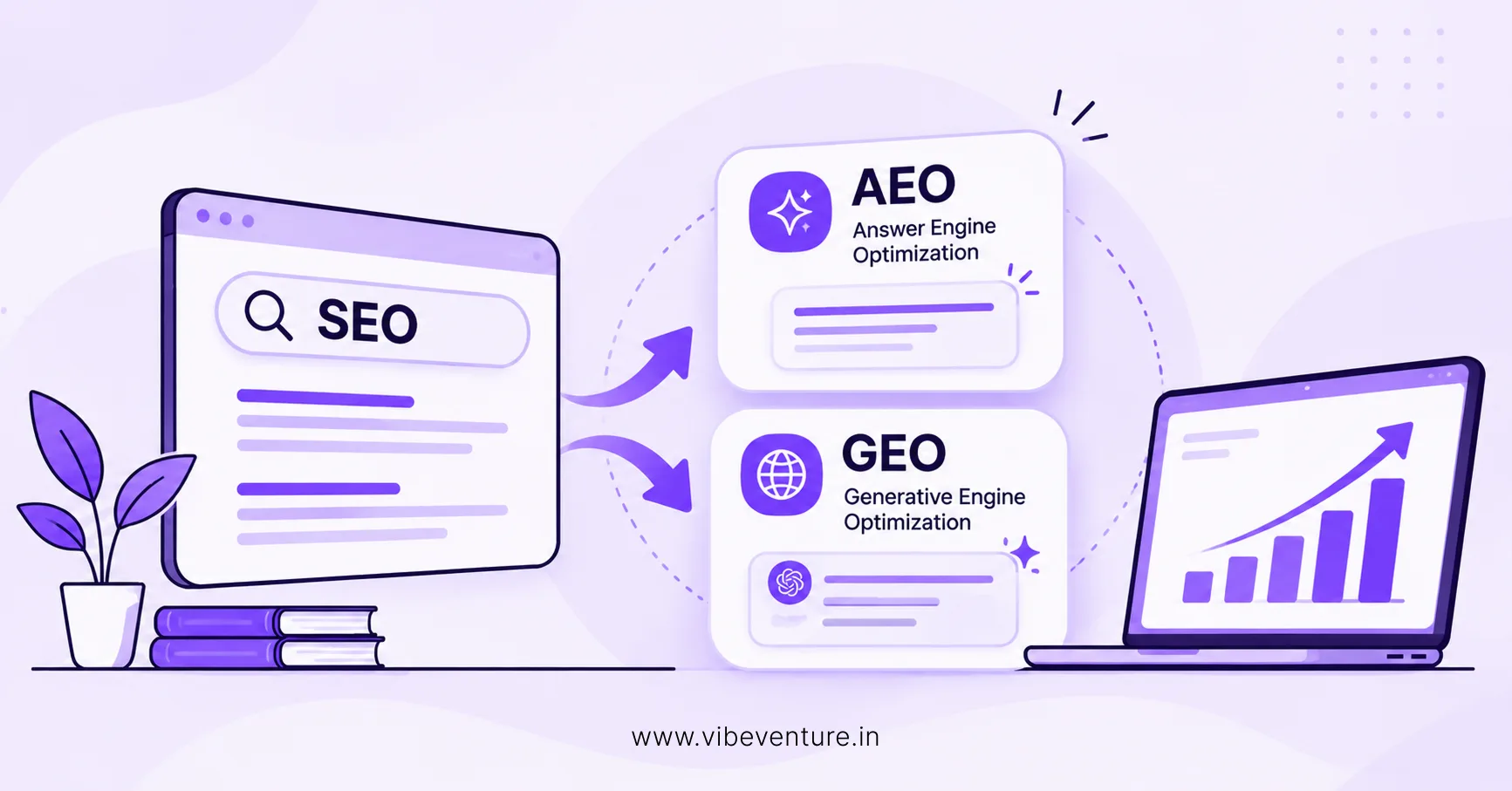
Traditional SEO remains important, but two additional concepts are receiving growing attention: Answer Engine Optimization (AEO) and Generative Engine Optimization (GEO).
The question is no longer just, "How do we rank on Google?"
Businesses must also consider, "How can our content become a useful, trustworthy source when AI systems answer questions?"
Let's explore what this means and how businesses can adapt.
What Is SEO, and Why Is It Still Important?
Search Engine Optimization is the process of improving a website so that search engines can discover, understand, and present its pages to relevant users.
Traditional SEO focuses on several key areas:
- Keyword research: Understanding what potential customers are searching for.
- Technical SEO: Ensuring that search engines can crawl and index website pages.
- On-page optimization: Improving titles, headings, content, internal links, and metadata.
- Content quality: Publishing useful, relevant, original information.
- Authority and trust: Building credibility through expertise, reputation, and relevant references.
- User experience: Making websites accessible, mobile-friendly, and easy to navigate.
For example, imagine a software company offering custom web development services. A potential customer searches for "best web development company for startups."
A well-optimized service page, supported by useful articles and credible business information, can help the company appear in relevant search results.
However, search experiences now go beyond traditional lists of blue links.
Google's guidance confirms that established SEO fundamentals remain relevant to its AI-powered search features. SEO has not disappeared; the ways users discover and interact with content are expanding.
What Is AEO (Answer Engine Optimization)?
Answer Engine Optimization focuses on structuring and presenting information so that it can effectively answer users' questions.
Rather than concentrating exclusively on rankings, AEO emphasizes clear answers, relevant context, and easily understandable content.
How does AEO work?
Suppose someone asks:
"What is website automation, and how can it help a small business?"
A useful page might begin with a direct answer:
"Website automation uses software to handle repetitive website-related tasks, such as lead capture, email notifications, appointment requests, and customer follow-ups."
The article can then explain the benefits, provide examples, and answer related questions.
This structure helps readers quickly understand the subject and makes the information easier to interpret.
Practical AEO strategies
- Answer the main question early in the article.
- Use descriptive headings that reflect real user questions.
- Explain technical concepts in simple language.
- Include relevant examples and step-by-step instructions.
- Use comparison tables and lists when they genuinely help readers.
- Keep important information in accessible, crawlable text.
- Use appropriate structured data that accurately reflects visible page content.
Example: A company publishing an article about Django development could include a section titled "Why Should Businesses Choose Django?" followed by a concise answer and supporting details.
The objective is to answer the user's question accurately—not to repeat keywords or manipulate search systems.
What Is GEO (Generative Engine Optimization
Generative Engine Optimization focuses on improving a brand's visibility in AI-generated responses and recommendations.
AI-powered search experiences may combine information from multiple sources to produce a summarized answer. Relevant websites can be presented as supporting links, depending on the system and the user's query.
GEO therefore emphasizes publishing distinctive, reliable, well-supported information that AI-powered systems can discover and potentially reference.
How does GEO work?
Imagine a business owner asks an AI assistant:
"Which technology solutions can help my company automate customer support and generate more leads?"
An AI-powered response might discuss chatbots, CRM integrations, workflow automation, and lead qualification.
A technology company that publishes genuinely useful explanations, practical implementation guides, and credible case studies may have more opportunities to be discovered during this research process.
However, appearing in an AI-generated answer is not guaranteed. Different systems use different methods, and their responses can change.
Practical GEO strategies
- Publish original research, useful insights, and real project examples.
- Demonstrate expertise with accurate, well-supported explanations.
- Make company services, experience, and business information clear.
- Keep website content current and technically accessible.
- Include descriptive headings, contextual links, and useful supporting media.
- Track AI-related referrals and visibility where reliable analytics are available.
GEO is not about writing exclusively for machines. It is about creating content that genuinely deserves to be discovered, understood, and referenced.
SEO vs AEO vs GEO: What's the Difference?
| Features | SEO | AEO | GEO |
|---|---|---|---|
| Primary focus | Search visibility and relevant traffic | clear answer to user Questions | visibility in generative AI responses |
| Typical discovery experience | Search engine results | Featured Anser and answer-oriented experiences | AI-generated summaries and recommendations |
| Content approach | Relevant, useful, well-optimized pages | Direct answers supported by context | Distinct,credible,Well-supported information |
| Important considerations | Crawlability, indexing, relevance, quality | Clarity, questions coverage,structure | Originality, trust, discoverability, relevance |
| Business objective | Attract relevant visitors | Help user find answer efficiently | Increase opportunities for brand discovery |
Why Is AI-Powered Search Changing Digital Marketing?
AI-powered search is influencing how users research products, compare service providers, and understand complex topics.
Here are five important changes businesses should consider.
Search queries are becoming more conversational
Users may ask detailed questions rather than enter short keyword phrases.
For example:
Traditional query: "Django development company"
Conversational query: "What should I look for when hiring a Django development company for a scalable business application?"
Businesses should create content that addresses the actual needs behind these questions.
Users want useful answers faster
People often want a clear explanation before deciding which website to visit.
Articles should provide direct answers, followed by enough detail to help readers make informed decisions.
Original expertise matters
Generic articles that repeat widely available information provide limited differentiation.
Businesses can strengthen their content by including original examples, lessons from real projects, expert commentary, and practical recommendations.
Brand credibility becomes increasingly important
Customers need reasons to trust the businesses they discover.
Clear service pages, genuine testimonials, transparent company information, and demonstrable expertise can help build that trust.
Website traffic is not the only useful metric
A business should consider qualified leads, enquiries, conversions, referral sources, and brand visibility alongside organic traffic.
AI search may influence customer discovery even when the impact is not immediately reflected in a single traffic metric.
- How Can Businesses Optimize Their Websites for SEO, AEO, and GEO?
Businesses do not necessarily need three separate marketing strategies. They can begin with a strong foundation and improve it systematically.
Step 1: Strengthen technical SEO
Check that your website:
- Can be crawled and indexed by search engines.
- Uses clear page titles and descriptive URLs.
- Has a logical internal-linking structure.
- Works well on mobile devices.
- Loads reliably and provides a good user experience.
- Makes important information available as accessible text.
Use Google Search Console to monitor indexing, search performance, and technical issues.
Step 2: Create helpful, question-focused content
Identify the questions customers ask before choosing your products or services.
For a software development company, these might include:
- How much does custom software development cost?
- When should a business automate its workflows?
- How do you choose the right technology stack?
- What is the difference between custom software and SaaS?
- How can a business improve its website's conversion rate?
Answer each question thoroughly, using practical examples and accurate information.
Step 3: Make content easy to understand
Use a logical structure:
- One clear H1 heading.
- Descriptive H2 and H3 headings.
- Short paragraphs where appropriate.
- Tables for meaningful comparisons.
- Lists for steps and recommendations.
- Definitions for unfamiliar terms.
Structure should improve readability rather than serve as a supposed shortcut to AI visibility.
Step 4: Demonstrate experience and expertise
Publish content that reflects what your business actually knows and does.
Useful additions include:
- Original project case studies.
- Before-and-after comparisons.
- Technical explanations from your team.
- Lessons learned during implementation.
- Measurable results when genuine data is available.
Never invent client testimonials, case studies, or performance statistics.
Step 5: Build a consistent brand presence
Keep your company name, services, contact information, and business descriptions accurate across your website and relevant business profiles.
Earn mentions and links through useful work, partnerships, original research, and genuine industry contributions rather than artificial link-building schemes.
Step 6: Measure results and improve
Track:
- Organic impressions and clicks.
- Search queries and landing-page performance.
- Qualified enquiries and conversions.
- Referral traffic from AI platforms, where measurable.
- Brand mentions and AI search visibility through reliable monitoring methods.
Do not assume that every AI mention can be tracked or attributed accurately. Use the data available to make informed decisions.
- Common AEO and GEO Mistakes to Avoid
As interest in AI search grows, so does the amount of advice promising quick results. Businesses should be careful about tactics that lack reliable evidence.
Avoid these common mistakes:
Keyword stuffing: Repeating phrases unnaturally makes content harder to read and does not create genuine value.
Publishing mass-produced, generic articles: Producing large quantities of low-value content is not a substitute for useful information and original expertise.
Assuming schema guarantees AI visibility: Structured data can help search engines understand content, but it does not guarantee rankings, citations, or AI-generated recommendations.
Creating unnecessary technical files for supposed AI rankings: Do not assume that special AI-specific files automatically improve visibility. Follow the official guidance for the search platforms you target.
Ignoring traditional SEO: Poor crawlability, indexing problems, weak content, and confusing navigation can still limit discovery.
Believing anyone can guarantee AI citations: AI-generated answers vary, and no legitimate optimization strategy can guarantee that a particular website will be mentioned.
The strongest approach is to prioritize proven fundamentals, original value, and continuous measurement.
- The Future of Search: One Strategy, Multiple Discovery Channels
The future of digital discovery will not necessarily belong to businesses that abandon SEO and focus exclusively on AI.
It will favor businesses that understand their customers, publish useful information, maintain technically sound websites, and adapt as search experiences evolve.
Consider a company that offers AI development and custom software services.
Its digital strategy could include:
- SEO-optimized service pages for customers actively comparing providers.
- AEO-friendly articles that answer common technical and business questions.
- GEO-oriented content that demonstrates original expertise and provides trustworthy information.
- Case studies that show how its solutions address real problems.
- Clear calls to action that help interested readers take the next step.
Together, these elements can support a more comprehensive online presence.
The objective is not simply to appear in more places. It is to help the right audience discover your business, understand your expertise, and confidently evaluate your services.
Conclusion: SEO Is Evolving, Not Disappearing
SEO is not dead. It is evolving alongside the ways people discover information online.
AEO encourages businesses to answer questions clearly. GEO encourages them to build visibility through useful, distinctive, and credible information in generative AI experiences. Traditional SEO continues to provide the technical and content foundation that supports discovery across search experiences.
For businesses looking to remain competitive, the next step is clear: build a strategy around people first, strong technical foundations, trustworthy expertise, and measurable business outcomes.
At Vibe Venture, we believe that effective digital growth starts with understanding how technology and customer behaviour are changing—and turning those changes into practical opportunities for businesses.
Ready to strengthen your digital presence?
Explore how the right digital strategy, website improvements, and AI-powered solutions can help your business reach its goals.
Discuss Your Project with Vibe Venture and take the next step toward a smarter digital strategy.
Frequently Asked Questions
- Is SEO dead in 2026?
No. SEO remains relevant for search visibility, crawling, indexing, content relevance, and website quality. AEO and GEO are complementary approaches for adapting content to answer-oriented and AI-generated search experiences.
- What is the difference between AEO and GEO?
AEO focuses on helping content answer users' questions clearly. GEO focuses on improving the chances of content and brands being discovered or referenced in generative AI experiences. Their methods overlap, and neither guarantees inclusion.
- Does GEO replace traditional SEO?
No. Foundational SEO practices remain important for discovery in Google's AI-powered search features. Businesses should build on SEO rather than abandon it.
- How can a small business get started with AEO and GEO?
Start by fixing technical SEO issues, answering customer questions clearly, publishing original expertise, keeping business information accurate, and monitoring results using available analytics tools.
- Does adding structured data guarantee AI visibility?
No. Structured data can help search engines interpret eligible content, but it does not guarantee search rankings or inclusion in AI-generated responses.
- How long does it take to see results from SEO, AEO, and GEO?
There is no universal timeline. Results depend on the website's current condition, competition, content quality, technical accessibility, authority, and the search platform involved. Monitor progress over time rather than expecting guaranteed short-term outcomes.