PHP Modernization: The Global Crisis in 2026
Discover why PHP modernization matters in 2026. Improve security, boost performance, and build a scalable, future-ready tech stack.
The future of PHP isn't the problem. Outdated technology is.
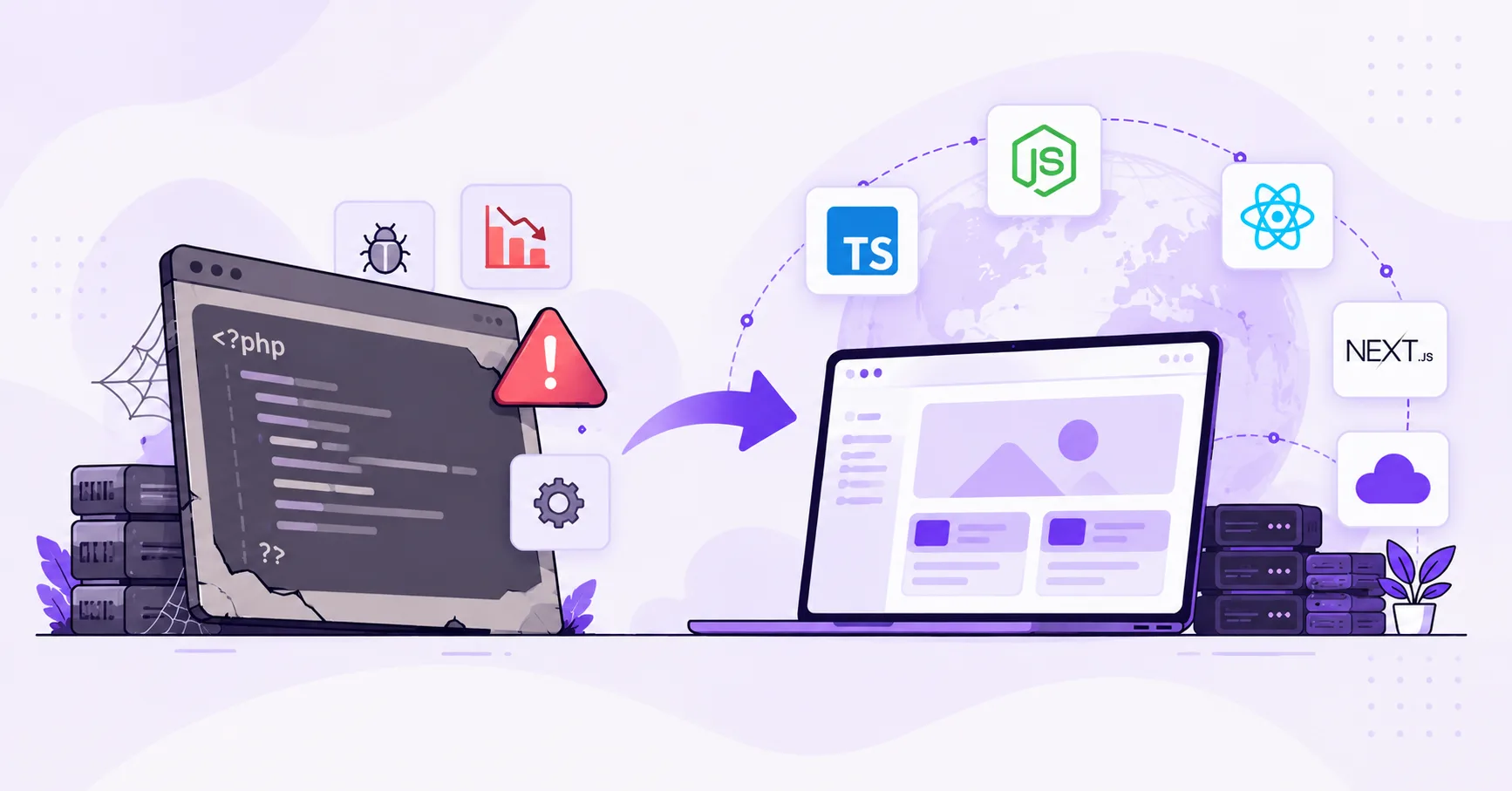
PHP remains a viable technology for modern web development, but outdated versions and vulnerable dependencies can expose businesses to security risks. PHP modernization helps organizations improve security, performance, and maintainability without automatically rewriting every application. The right approach is to assess each system and decide whether to upgrade, refactor, or migrate.
Businesses worldwide are under increasing pressure to deliver secure, scalable, high-performance digital experiences. Yet many organizations continue to depend on legacy PHP applications, outdated dependencies, and aging infrastructure that can make modernization difficult.
In 2026, the conversation around PHP modernization is more relevant than ever. Security maintenance, evolving development practices, application performance, and changing business requirements are forcing organizations to reconsider how they manage their technology stacks.
PHP remains a powerful technology for web development. However, running an unsupported PHP version or maintaining an application that no longer meets modern requirements can expose businesses to unnecessary risks and operational challenges.
So, is PHP facing a crisis, or are businesses facing the consequences of delaying modernization?
The answer matters for every organization that relies on PHP-powered websites, e-commerce platforms, content management systems, or enterprise applications.
In this guide, we'll explore the challenges facing legacy PHP applications, the importance of upgrading your technology stack, and the practical steps businesses can take to build more secure, scalable, and future-ready digital platforms.
What Is the Global PHP Crisis?
The term "global PHP crisis" describes the growing challenges organizations face when maintaining legacy PHP applications in a rapidly evolving technology landscape.
It does not mean PHP is becoming obsolete. Modern PHP continues to evolve, and frameworks such as Laravel and Symfony provide structured approaches to building maintainable web applications.
The real problem lies in the gap between modern development requirements and outdated implementations.
Many businesses still operate applications built around older PHP versions, unsupported libraries, tightly coupled code, and infrastructure that has not kept pace with changing requirements.
These systems may continue to function, but maintaining them can become increasingly difficult.
Common challenges include:
- Unsupported PHP versions and outdated dependencies.
- Increasing cybersecurity and compliance risks.
- Performance bottlenecks and database inefficiencies.
- Difficult integrations with modern APIs and cloud services.
- Limited automated testing and unreliable deployments.
- Rising maintenance costs and slower feature development.
Over time, these challenges can affect more than the development team. They can slow product launches, disrupt customer experiences, increase operational risk, and limit business growth.
The real PHP crisis is not the technology itself. It is the growing cost of maintaining technology that no longer serves the business effectively.
1. PHP Security in 2026: Why Staying Updated Matters
Security is one of the strongest reasons to review an existing PHP technology stack.
The PHP project provides defined support lifecycles for its releases. After active support ends, a branch receives security fixes for a limited period before reaching end of life.
Once a version is no longer supported, businesses cannot rely on the upstream project to provide routine security fixes for newly discovered vulnerabilities.
This makes version management an essential part of application security.
Why outdated PHP applications are vulnerable
An aging PHP application may contain several layers of technical risk:
- An unsupported PHP runtime.
- Vulnerable third-party packages.
- Outdated frameworks, plugins, or extensions.
- Weak authentication and authorization controls.
- Inadequate input validation and output encoding.
- Poorly managed secrets and database credentials.
- Limited security monitoring and incident response capabilities.
Even when the underlying PHP runtime is supported, vulnerable application dependencies or insecure coding practices can leave the system exposed.
A timely security reminder for 2026
On October 21, 2026, the PHP project announced security releases addressing critical vulnerabilities affecting PHP 8.5, 8.4, 8.3, and 8.2. The releases included PHP 8.5.12, 8.4.27, 8.3.36, and 8.2.35.
Organizations running affected versions should consult the official advisory and apply the appropriate security updates after validating their deployment requirements.
Official resources:
This illustrates an important distinction: modernization is not simply about moving to a newer technology. It also involves maintaining supported software, monitoring security advisories, and responding to vulnerabilities promptly.
How PHP modernization improves security
A structured modernization initiative can help organizations:
- Upgrade to a supported PHP release compatible with their application.
- Replace vulnerable or abandoned dependencies.
- Introduce automated dependency and vulnerability scanning.
- Improve authentication, authorization, and input validation.
- Strengthen logging, backups, and recovery procedures.
- Establish a repeatable patch management process.
Upgrading the runtime alone does not guarantee a secure application. The entire software stack must be reviewed, tested, and maintained.
2. Legacy PHP Applications Are Increasing the Cost of Maintenance
Many organizations delay modernization because their existing applications still work.
However, functioning software is not necessarily maintainable software.
Legacy applications can accumulate years of quick fixes, undocumented business rules, outdated dependencies, and tightly coupled components. Over time, even a small change may require extensive investigation and testing.
This is commonly known as technical debt.
The hidden business impact of technical debt
Consider a business operating an older PHP-based customer portal.
A simple feature request might require developers to investigate undocumented code, resolve dependency conflicts, manually test multiple workflows, and coordinate a risky production deployment.
What should be a straightforward improvement becomes a time-consuming project.
The consequences can include:
- Higher ongoing maintenance costs.
- Slower delivery of new features.
- Increased regression risk.
- Greater dependence on a small number of experienced developers.
- Reduced ability to respond to customer feedback.
Technical debt is not always a reason to rewrite an application. The priority is to understand which parts create the greatest cost or risk and address them systematically.
Modernization creates room for innovation
A maintainable codebase, supported dependencies, automated testing, and clear architecture allow developers to focus more of their time on delivering business value.
Instead of repeatedly working around legacy limitations, teams can build integrations, improve customer journeys, and introduce new capabilities with greater confidence.
3. Performance and Scalability: Can Your PHP Application Handle Growth?
Application performance directly affects how customers experience a digital product.
Slow page loads, delayed API responses, unreliable checkout flows, and timeouts during traffic spikes can damage customer satisfaction and operational efficiency.
However, poor performance should not automatically be blamed on PHP.
The underlying cause may be inefficient SQL queries, missing database indexes, excessive network requests, poor caching strategies, insufficient server resources, or an application architecture that does not suit its workload.
Common performance issues in legacy PHP systems
Inefficient database queries: Repeated queries and missing indexes can increase response times as data grows.
Limited caching: Recomputing the same results for every request can waste CPU and database resources.
Synchronous background operations: Sending emails, generating reports, or processing large files during a user request can make applications feel slow.
Infrastructure bottlenecks: Poor resource allocation or unsuitable hosting configurations can prevent applications from handling traffic efficiently.
Insufficient observability: Without meaningful metrics and tracing, identifying the source of a bottleneck becomes difficult.
How to modernize PHP application performance
A performance-focused modernization plan may include:
- Upgrading to an appropriate supported PHP version.
- Profiling slow endpoints and optimizing expensive operations.
- Improving database queries and indexing.
- Implementing suitable caching mechanisms.
- Moving time-consuming tasks to background queues.
- Using load testing to evaluate peak traffic scenarios.
- Improving monitoring and infrastructure configuration.
Measure performance before and after each major change. Useful indicators include response-time percentiles, error rates, throughput, resource utilization, and database latency.
This makes performance improvement measurable rather than subjective.
4. PHP 8.5 and the Evolution of Modern PHP Development
A common misconception is that PHP has stopped evolving.
In reality, the PHP ecosystem continues to introduce language improvements, runtime updates, and development capabilities.
PHP 8.5, released in November 2025, introduced features including a built-in URI extension, a pipe operator, and improved object cloning syntax.
These improvements help demonstrate that PHP remains an actively developed language.
However, adopting a newer PHP version requires more than changing a server configuration.
Applications must be evaluated for compatibility with frameworks, extensions, third-party packages, and existing code.
What businesses should evaluate before upgrading
Before moving to a newer PHP release, teams should:
- Check the official support lifecycle and current patch releases.
- Verify framework and library compatibility.
- Review deprecated features and backward-incompatible changes.
- Run automated tests and static analysis.
- Test critical workflows in a staging environment.
- Plan deployment, monitoring, and rollback procedures.
Not every application needs the newest release immediately. The right target depends on support status, compatibility, business requirements, and the organization's ability to test and deploy safely.
The objective is to maintain a supported, reliable environment while preparing the application for future upgrades.
5. Modern PHP Frameworks and Development Tools
A modern technology stack is about more than the programming language.
Frameworks, dependency management, testing tools, deployment automation, and monitoring practices all contribute to application quality.
Laravel
Laravel provides a structured framework for developing PHP applications with features such as routing, authentication support, database access, queues, caching, and automated testing.
It can be a suitable option for teams building or modernizing business applications that benefit from a cohesive development ecosystem.
Symfony
Symfony provides reusable components and a flexible framework for applications requiring structured architecture and long-term maintainability.
It can be useful for enterprise applications and systems that need clearly defined application components.
Composer
Composer manages PHP dependencies and supports reproducible dependency installation. It is an essential tool for maintaining and updating modern PHP projects.
PHPUnit and PHPStan
PHPUnit supports automated testing, while PHPStan helps identify potential errors through static analysis.
Used appropriately, these tools can reduce regression risk and make refactoring safer.
CI/CD and containerization
Continuous integration and continuous delivery practices help automate testing, build processes, and deployment workflows.
Containers can also make application environments more consistent across development, testing, and production.
No single framework or tool automatically solves legacy problems. The right combination depends on the existing application, team expertise, and business requirements.
6. Should You Modernize PHP or Migrate to Another Technology?
One of the biggest mistakes organizations make is assuming that modernization always requires abandoning PHP.
A complete rewrite can introduce significant cost, delivery delays, and migration risk. It may also require rebuilding business logic that already works.
In many cases, upgrading the existing application is a more practical approach.
There are three primary modernization strategies.
Option 1: Upgrade the existing PHP application
Upgrade the PHP runtime, replace unsupported dependencies, resolve compatibility issues, and improve automated testing.
This approach is often appropriate when the application remains valuable and its architecture is reasonably maintainable.
Best suited for: Businesses seeking better security, maintainability, and compatibility without replacing their entire system.
Option 2: Refactor and modernize the architecture
Improve the internal structure of the application, separate responsibilities, introduce well-defined APIs, and move resource-intensive tasks into background processing where appropriate.
A modular monolith may be sufficient for many applications. Microservices should be considered only when their independent deployment, scaling, or organizational benefits justify the added operational complexity.
Best suited for: Applications experiencing increasing complexity, integration challenges, or specific scaling limitations.
Option 3: Migrate to another technology
A migration may be justified when the current platform cannot meet essential business requirements or when a replacement provides a compelling long-term advantage.
However, the decision should be based on measurable business needs, total cost of ownership, available skills, and migration risk—not the assumption that another language is automatically better.
Best suited for: Businesses facing fundamental limitations that cannot be addressed economically through incremental modernization.
The best strategy is the one that improves business outcomes while managing technical and operational risk.
7. A Step-by-Step PHP Modernization Roadmap for 2026
Successful modernization requires a clear plan, realistic priorities, and measurable results.
Step 1: Conduct a comprehensive technology audit
Document your existing environment, including:
- PHP versions and extensions.
- Frameworks and third-party dependencies.
- Database systems and integrations.
- Hosting and deployment infrastructure.
- Testing and monitoring capabilities.
- Known security and performance issues.
Identify unsupported components and determine which systems are most critical to business operations.
Step 2: Prioritize security and support risks
Create an inventory of unsupported software, known vulnerabilities, and components that no longer receive maintenance.
Address urgent security issues first. Establish a plan for supported runtime versions and ongoing dependency maintenance.
Step 3: Define measurable modernization goals
Set clear objectives before changing the system.
Examples include reducing critical vulnerabilities, improving API response times, decreasing deployment failures, or shortening the time required to release a feature.
Establish a baseline so that improvements can be measured accurately.
Step 4: Establish automated testing
Begin with the workflows that matter most to the business, such as authentication, payments, order processing, reporting, and customer data management.
Introduce automated tests where they provide meaningful protection against regressions.
If test coverage is limited, build it gradually around critical functionality before making extensive changes.
Step 5: Upgrade incrementally
Break modernization into manageable phases.
Upgrade dependencies, resolve compatibility problems, refactor high-risk code, and validate changes in a staging environment.
For larger systems, phased migration can reduce the need for a disruptive, all-at-once replacement.
Step 6: Improve deployment and monitoring
Automate repeatable deployment tasks, establish rollback procedures, and monitor application health.
Track errors, response times, resource consumption, and important business transactions to identify issues quickly.
Step 7: Make modernization continuous
Schedule regular security reviews, dependency updates, performance assessments, and architecture evaluations.
Assign clear ownership for maintenance so that the application does not accumulate avoidable technical debt again.
A modernization roadmap should be an ongoing engineering practice—not a one-time project that ends when a new version is deployed.
8. The Business Benefits of Modernizing Your Tech Stack
The value of PHP modernization extends well beyond code quality.
When aligned with business objectives, it can support measurable improvements across technology operations and customer experience.
Improved security and reduced risk
Supported software, timely patches, and stronger engineering practices help organizations manage security risks more effectively.
Better application performance
Profiling, database optimization, caching, and infrastructure improvements can reduce bottlenecks and support a smoother user experience.
Faster development cycles
Automated tests, maintainable architecture, and consistent deployment processes can make changes easier to deliver and validate.
Lower maintenance overhead
Reducing unnecessary complexity and replacing unsupported components can make routine maintenance more predictable.
Improved scalability
Appropriate architectural and infrastructure changes help applications accommodate growth without introducing unnecessary complexity.
Greater flexibility for future innovation
A well-maintained technology stack makes it easier to integrate new services, respond to changing customer needs, and evaluate emerging technologies.
These outcomes depend on implementation quality and project scope. Modernization should therefore be evaluated through measurable business results rather than the number of new technologies adopted.
9. What Happens If You Delay Modernization?
Delaying modernization can appear less expensive in the short term, especially when an application continues to function.
However, the cost of postponement can increase as software becomes harder to maintain.
Dependencies may become unsupported, compatibility issues may accumulate, and developers may need more time to understand undocumented functionality.
Security maintenance can become more difficult, while new integrations and business requirements may demand increasingly complex workarounds.
Eventually, organizations may face a situation where urgent maintenance competes directly with planned product development.
This does not mean every legacy application requires an immediate rewrite. It means businesses should understand their exposure and prioritize improvements before technical limitations become business-critical. Our software development services can help businesses plan a modernization approach based on their specific requirements.
A practical modernization plan can spread investment over time and focus resources on the areas with the greatest impact.
10. How to Measure the Success of PHP Modernization
A successful modernization project should produce measurable improvements.
Before starting, identify a small set of indicators that reflect your actual goals.
| Area | What to measure |
|---|---|
| Security | Unsupported components, unresolved vulnerabilities, patching time |
| Performance | Response-time percentiles, error rates, database latency |
| Delivery | Deployment frequency, failed deployments, recovery time |
| Maintainability | Defect rates, change lead time, recurring maintenance effort |
| Reliability | Availability, incident frequency, recovery performance |
| Business outcomes | Conversion rates, support volume, feature delivery time |
Establish a baseline, define realistic targets, and compare results after implementation.
Not every metric will improve immediately. A large upgrade may initially require additional testing and remediation work. Evaluating results over an appropriate period gives a more accurate picture of long-term value.
Frequently Asked Questions About PHP Modernization
Is PHP becoming obsolete in 2026?
No. PHP continues to evolve and remains a viable choice for modern web developmen. The primary concern is the use of unsupported versions, vulnerable dependencies, and legacy application architectures that no longer meet business needs.
Why should businesses modernize legacy PHP applications?
Modernization can help businesses improve security maintenance, application performance, scalability, developer productivity, and long-term maintainability. The appropriate benefits depend on the condition of the existing system and the goals of the project.
What is the latest PHP version businesses should use?
PHP 8.5 is the latest major release branch as of October 2026. However, the correct production version depends on the official support lifecycle, current security patches, application compatibility, and hosting environment. Always check the official PHP supported versions page before planning an upgrade.
Is upgrading PHP enough to modernize an application?
Not necessarily. A runtime upgrade may address support and compatibility concerns, but broader modernization may require dependency updates, code refactoring, automated testing, performance optimization, infrastructure improvements, and better monitoring.
Should a business rewrite its legacy PHP application?
A rewrite is not always necessary. Incremental upgrades and refactoring are often more practical when the existing application still meets core business needs. A complete rewrite should be supported by a clear business case.
How much does PHP modernization cost?
Costs vary depending on application size, code quality, integrations, security requirements, testing coverage, and the chosen modernization strategy. A technical audit and phased roadmap can help establish a more realistic estimate.
How can I tell whether my PHP application needs modernization?
Warning signs include an unsupported PHP version, abandoned dependencies, recurring security issues, slow response times, difficult deployments, increasing maintenance effort, and an inability to implement important business features reliably.
Conclusion: Modernize Before Legacy Technology Limits Your Growth
Businesses that need expert guidance can explore our software development services to plan a secure, scalable, and practical modernization strategy. Contact our team to discuss your business requirements and next steps.
Businesses that depend on legacy PHP applications must evaluate whether their current systems remain secure, maintainable, and capable of supporting future requirements.
From upgrading supported PHP releases and addressing security vulnerabilities to improving application architecture and automating deployment, modernization provides a structured way to reduce technical risk and prepare for growth.
The right approach is not necessarily to replace everything. It is to identify the most important problems, prioritize improvements according to business value, and make changes in manageable, measurable stages.
Your technology stack should accelerate innovation—not slow it down.
If your business relies on a legacy PHP application, start with a technology audit. Identify unsupported components, assess security and performance risks, and create a modernization roadmap that supports your long-term goals.
The best time to address technical debt is before it becomes a barrier to business growth.
Ready to modernize your PHP application? Evaluate your current technology stack, identify the highest-priority improvements, and build a practical plan for a more secure, scalable, and maintainable digital future.